

_edited.png)


Oak Pollen vs. Your Clear Coat: The Hidden Danger of Parking Under Trees in Mandarin
- paulceki1205
- Mar 13
- 3 min read

If you live in Mandarin, you know the spring season isn't marked by flowers blooming, but by the unavoidable layer of sticky, yellow dust covering everything. Waking up to a "yellow sweater" on your car is just part of life here.
While that yellow haze is a major trigger for allergies, at Jacksonville Detailing, we know the bigger, more critical threat it poses. Most people assume that heavy coat of pollen is just messy and a nuisance, but if you value your vehicle's finish, you need to understand the "Silent Destroyer" that’s currently eating away at your paint.
We’re here to look at the first principles of what that pollen actually is, and why it’s a direct attack on your car's clear coat.

Understanding the Enemy: Why Oak Pollen Isn't Just "Dust"
Pollen isn't just inert dirt; it's biologically active. Its primary job is to fertilize trees, and the structure and chemistry are specifically designed for that purpose. For your car's paint, it creates a perfect storm of chemical and mechanical damage.
The Hidden Acidity (The Chemical Attack): Pollen grains are tough, but they contain acidic enzymes. When the pollen sits on your car’s surface and is exposed to the slightest bit of moisture—like our heavy Florida dew or a brief afternoon shower—those enzymes are activated. The pollen becomes highly acidic, creating tiny reservoirs of corrosive liquid. This acid doesn't just sit on the surface; it actively etches its way into your clear coat. Ignore it for just 4-5 days, and that acid can cause permanent pitting and damage to your finish.
The Abrasive Quality (The Mechanical Attack): Look at pollen under a microscope, and it doesn't look like dust. Its surface is covered in microscopic hooks and spikes. This is how it hitches a ride on bees and wind. But when that sticky, spiky dust is sitting on your paint, it acts exactly like thousands of tiny, microscopic razor blades or coarse-grit sandpaper. This is why wiping that "dust" off dry is one of the worst things you can do—you are actively creating thousands of micro-scratches and swirl marks.
The Jacksonville Detailing Guide to Pollen Defense
So, if you’re parking under the beautiful oaks in Mandarin, how do you fight back? The goal is to safely remove the abrasive material and then create a strong chemical barrier.
Rule #1: NEVER Dry Wipe: We know the urge to quickly wipe a spot on the window or hood, but don't do it. Your car’s paint cannot withstand that kind of friction from a dry, spiky contaminant.
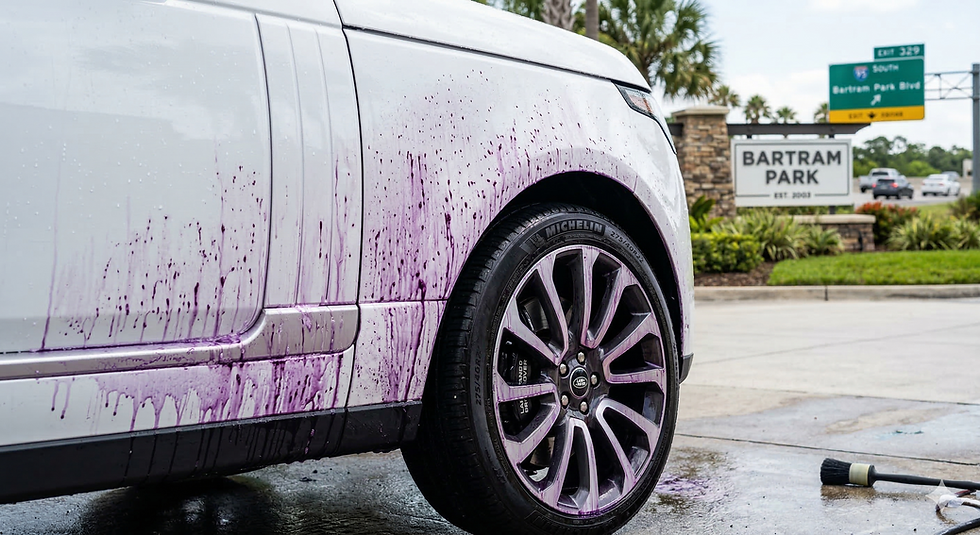
The Professional Decontamination Wash: To safely remove pollen without micro-scratching, you need a high-lubrication, touchless approach followed by a proper two-bucket wash. At Jacksonville Detailing, we start with a heavy, thick layer of foam designed to fully encapsulate and lift those spiky pollen grains, allowing them to be safely rinsed away before we ever touch the vehicle with a wash mitt. This eliminates the chance of scratching.
Your Best Defense: The Sacrificial Barrier (Ceramic Protection)
The final key to saving your clear coat from the oak pollen assault is protection. You must create a physical and chemical layer between the pollen and your paint.
Waxes are a step in the right direction, but they can break down in our Florida heat and can be softened by acids. The ultimate solution is a Professional Ceramic Coating.
A ceramic coating doesn’t just sit on your paint; it chemically bonds with your clear coat to create a microscopic, diamond-hard, hydrophobic shield.
Acid Resistance: Pollen acids have to eat through the durable, permanent ceramic layer first, making it nearly impossible for them to ever reach your paint.
Pollen-Repellent: The smooth, glass-like surface created by a ceramic coating is incredibly slick. Pollen, dust, and grime struggle to get a grip and are significantly easier to rinse away with a simple maintenance wash.
Protecting your car’s finish with a quality sealant or coating doesn't just save you from costly paint correction later—it creates that "Diamond Level" look your vehicle deserves.
Don’t let this spring’s yellow haze ruin your paint. We offer specialized pollen-removal details and permanent ceramic coatings designed to keep your car’s value and shine high, no matter where you park in Mandarin.
Contact Paul Ceki today to schedule your spring defense detail:
Website: jacksonvilledetailing.com
Phone: 904-228-0074
Email: paulceki1205@gmail.com

Comments